

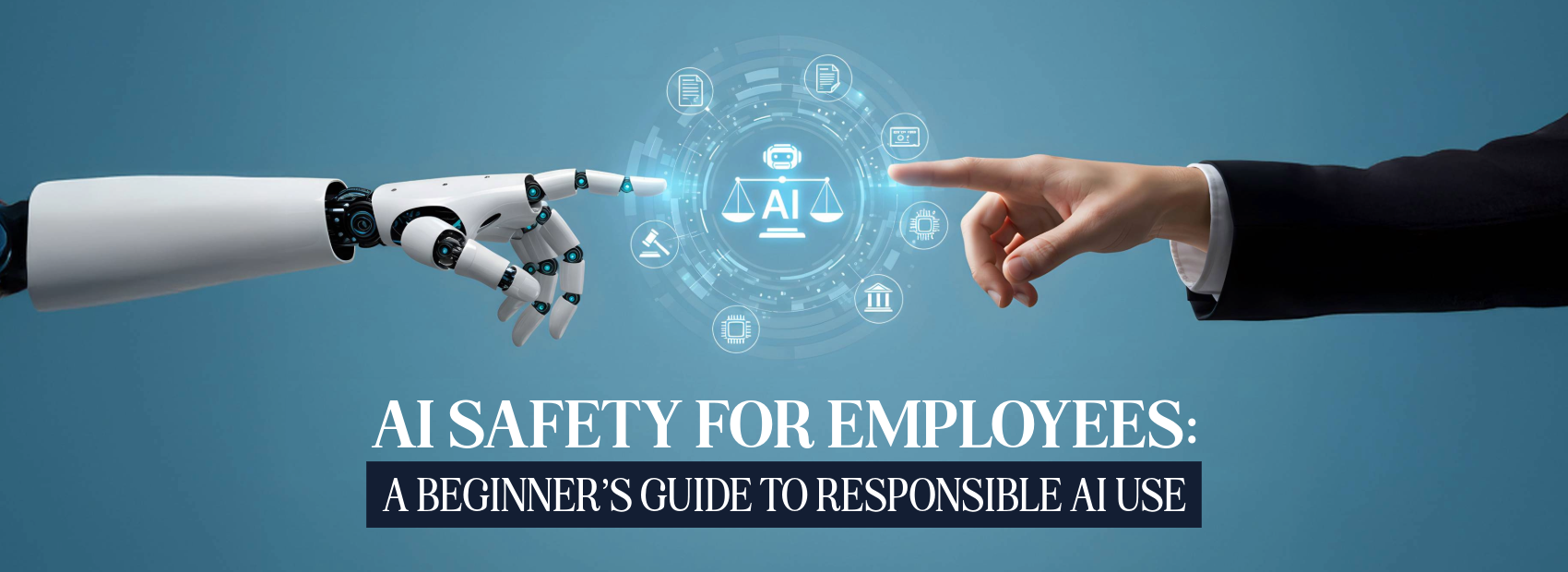
AI Safety for Employees Starts with Clear Guidance
Artificial intelligence is no longer experimental. It is already part of everyday work for many employees across UK small and medium-sized enterprises (SMEs). Staff are using AI tools to draft emails, summarise documents, organise tasks, and support decision-making.
While the benefits are clear, the risks increase just as quickly. That is why AI safety for employees must be addressed early, clearly, and practically.
Without guidance, employees may paste client data into public AI tools, upload sensitive documents, or rely on inaccurate outputs. Any of these actions can create data protection risks, compliance concerns, or reputational damage.
The good news is that most AI-related risks are preventable. With straightforward rules and basic awareness, UK SMEs can enable AI use safely and responsibly.
This guide explains how to introduce practical AI safety for employees without complexity or heavy technical requirements.
Why AI Safety for Employees Matters to UK SMEs
Technology evolves quickly. Workplace behaviour does not. Employees will naturally use tools that save time, especially when guidance is unclear or missing.
In the UK, a single misuse of AI can create issues under UK GDPR, contractual obligations, or sector-specific regulations. Even well-secured organisations can face problems if data is shared incorrectly through an AI platform.
AI safety for employees is not about stopping innovation. It is about helping people understand boundaries so AI can be used confidently and appropriately.
AI Safety for Employees Begins with Data Awareness
The most important rule for safe AI use is simple:
Employees must not enter confidential, personal, or regulated data into public AI tools.
This applies regardless of how helpful the tool appears.
Help employees understand what “sensitive data” means
Many employees unintentionally take risks because they do not recognise sensitive information. Clear, practical examples help remove uncertainty.
Sensitive data typically includes:
- Personal data covered by UK GDPR
- Medical or health-related information
- Financial records or payroll details
- Client names, addresses, or reference numbers
- Contracts, legal correspondence, or case notes
- Internal pricing, strategy, or business plans
- Passwords, credentials, or system configurations
Providing a short checklist encourages employees to pause before using AI tools.
Build AI Safety for Employees with Clear Tool Approval
One of the most effective ways to reduce AI risk is to clearly define which tools are approved for business use. UK SMEs do not need many tools, but they do need clarity.
Commonly approved tools may include:
- Microsoft Copilot within Microsoft 365
- AI features built into Teams, Outlook, and SharePoint
- Business-grade AI platforms with clear data controls
Tools that typically introduce higher risk include:
- Free consumer AI applications
- Browser extensions that read page content
- Unverified document or image conversion tools
- AI services with unclear data storage or retention policies
When employees know which tools are approved, they are less likely to experiment with unsafe alternatives.
AI Safety for Employees Requires Prompt Discipline
How employees phrase requests to AI tools matters. Poorly written prompts can unintentionally expose sensitive information.
Example: unsafe vs safer prompts
Unsafe prompt:
“Review this client agreement for risks. The client is a care provider in Leeds, and their service users include…”
Safer prompt:
“Review this example agreement template for general risk considerations.”
This small adjustment protects personal and client data while still allowing employees to benefit from AI support.
Keep a Human Review Step in Every AI Workflow
AI can draft, summarise, and organise information. It cannot take responsibility for accuracy, context, or judgement.
Good practice for UK SMEs includes:
- Reviewing AI-generated content before use
- Checking facts against trusted sources
- Looking for missing context or assumptions
- Ensuring language matches the organisation’s tone
- Confirming outputs meet regulatory or contractual requirements
AI should assist employees, not replace accountability.
Set Clear Limits on AI Automation
Many AI tools now offer workflow automation. These features can be helpful but should be used carefully.
Lower-risk automation examples:
- Summarising meeting notes
- Drafting internal templates
- Creating task reminders
- Organising documents
Higher-risk automation examples:
- Automatically emailing clients
- Approving payments or financial decisions
- Sharing confidential files
- Responding to regulatory or compliance matters
Clear limits prevent unintended actions and protect the business.
Creating a Simple AI Safety Policy Employees Will Follow
UK SMEs do not need lengthy policies. They need clarity and accessibility. A good AI safety policy should be short, practical, and easy to reference.
A simple policy typically covers:
- Approved AI tools
- Data handling rules
- What must never be entered into AI systems
- Expectations for reviewing AI output
- Record-keeping considerations
- UK GDPR awareness
- Real examples of acceptable and unacceptable use
If employees can understand it quickly, they are far more likely to follow it.
Use UK Guidance to Reinforce Responsible AI Use
Trusted UK guidance can support internal training and policy development, including:
- Information Commissioner’s Office (ICO): UK GDPR and data protection guidance
- National Cyber Security Centre (NCSC): Cyber security best practices
- NHS Data Security and Protection Toolkit: For health and care organisations
- UK Government AI guidance: Responsible adoption principles
These resources align AI use with UK legal and security expectations.
Supporting Safe, Practical AI Adoption for UK SMEs
AI can improve productivity and efficiency for UK SMEs, but only when employees understand how to use it safely. Clear guidance protects client data, reduces compliance risk, and builds confidence across teams.
As a UK MSP, we help organisations adopt technology responsibly. That includes:
- Defining safe AI use cases
- Aligning AI tools with UK data protection obligations
- Training employees in clear, practical language
- Introducing governance without slowing the business down
If you would like to support the safe introduction of AI within your organisation, we are happy to help.
Contact us to discuss responsible AI adoption for your business.