

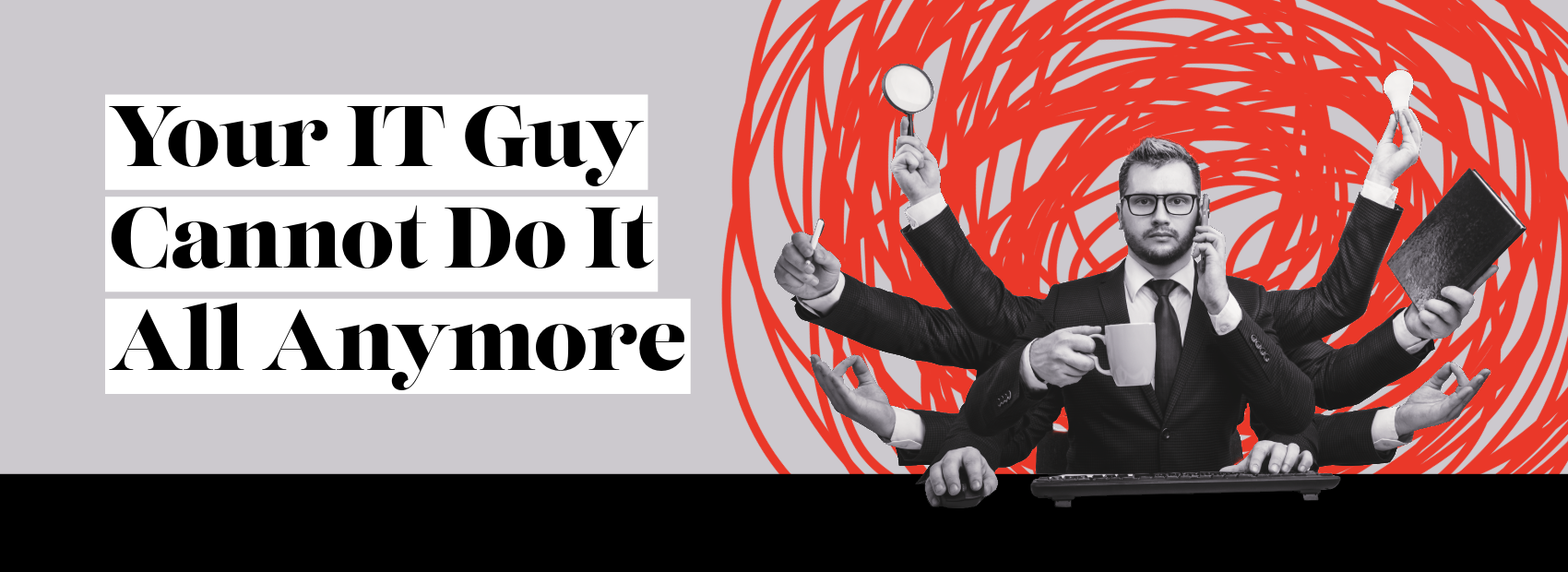
Your IT Guy Cannot Keep Up with Everything
Most businesses have someone they rely on.
It may be an internal IT manager. It may be a long-term IT partner. In some cases, it is simply the person who became responsible because they understand technology better than others.
For a while, this works.
Requests are handled. Systems stay online. Problems get resolved.
However, the scope of technology has changed.
Cyber security, compliance, cloud management, user support, supplier coordination, backups, monitoring, and response planning now require constant attention.
In many UK SMEs, all of this is still expected from one person.
That is where risk begins to build.
The Role Has Outgrown the Resource
Technology is no longer a single function.
It is a collection of responsibilities that require depth and consistency.
These include endpoint security, identity and access management, cloud infrastructure, compliance requirements, and supplier oversight.
Guidance from the National Cyber Security Centre outlines multiple areas businesses must manage continuously to reduce operational and cyber risk.
At the same time, the Information Commissioner’s Office reinforces the importance of protecting personal data, maintaining clear processes, and responding properly to incidents.
This is no longer a single-person role.
What Happens When One Person Owns Everything
When responsibility is concentrated, prioritisation becomes necessary.
Some work is completed. Other work is delayed.
Security reviews are pushed aside. Documentation becomes inconsistent. Strategic planning is replaced by daily support requests.
This is not a failure of the individual.
It is a limitation of the structure.
No one can maintain full coverage across every area all the time.
The Risk No One Talks About
The issue is not just workload.
It is exposure.
When one person owns everything, the business creates a single point of failure.
That risk can appear in several ways.
Burnout can reduce effectiveness. Absence can delay response. Gaps in expertise can leave vulnerabilities unaddressed.
Research from IBM shows that delays in detection and response increase the impact of cyber incidents.
If everything depends on a single individual, those delays become more likely.
Loyalty Can Hide the Problem
Business owners often trust their IT resources.
That trust is earned.
However, it can also create assumptions.
Many believe everything is covered. Many assume issues would be raised if they existed.
The reality is more complicated.
In many cases, the IT resource is aware of the gaps. They simply do not have the time or capacity to address everything fully.
What Support Actually Looks Like
The answer is not replacement.
The answer is support.
Modern IT requires a broader approach, even for smaller organisations.
That means shared responsibility across key areas. It means improved visibility across systems and security. It means having support available for escalation and response.
It also means allowing time for planning instead of constant reaction.
When support is introduced correctly, the internal IT resource becomes more effective.
The Shift from Overloaded to Aligned
When businesses move beyond the single-resource model, the impact becomes obvious.
Operations become more structured. Coverage improves. Pressure is reduced.
Instead of reacting to problems, the business begins managing technology with purpose.
This shift allows IT to support growth rather than simply maintain stability.
Most Businesses Wait Until Something Breaks
The pattern is familiar.
Everything feels manageable until a failure occurs.
A system goes offline. A security issue appears. Internal resources become unavailable.
At that point, the dependency becomes visible.
That is not the best time to make a change.
Build Around the Person, Not on Top of Them
If your business relies heavily on one individual, that is common.
However, it raises an important question.
What happens if that person is unavailable tomorrow?
What happens if a complex issue appears outside their area of expertise?
These are practical considerations.
The goal is not to replace the person.
The goal is to ensure they are supported.
Strengthen What You Already Have
If your IT resource is performing well, that is a strong starting point.
The next step is reinforcement.
A simple review can identify where responsibilities are concentrated and where gaps may exist.
From there, support can be introduced in a way that strengthens the overall environment without disruption.
FAQ: Your IT Guy Cannot Do Everything
Q: Why can one IT person not handle everything anymore?
A: The scope of IT has expanded significantly. It now includes cyber security, compliance, cloud management, user support, and strategic planning. No single person can maintain deep expertise and consistent execution across all these areas.
Q: Is this a problem with the IT person or the structure?
A: This is almost always a structural issue. Most IT professionals are capable and committed. However, expecting one person to manage everything creates natural limitations and increases risk.
Q: What is the biggest risk of relying on one person?
A: The biggest risk is creating a single point of failure. If that person is unavailable or overwhelmed, critical tasks may be delayed or missed.
Q: Should businesses replace their internal IT resource?
A: In most cases, no. The better approach is to support them with additional resources, tools, or external expertise. This strengthens the environment while preserving internal knowledge.
Q: How can an SME improve this situation?
A: Start by reviewing current responsibilities and identifying gaps. Then introduce support in key areas such as cyber security, monitoring, or planning.